
Your buyers are on LinkedIn right now scrolling, posting, making decisions. Yet most B2B teams walk away with a handful of ignored connection requests and zero meetings booked.
The problem isn’t LinkedIn. It’s the strategy problem which you are using for outreach.
LinkedIn generates 80% of all B2B leads from social media. It hosts over a billion professionals, including 2.8 million decision-makers and 260,000 C-suite executives. Four in five LinkedIn members drive business decisions and carry twice the buying power of average web users.
That’s not a social network. That’s your pipeline waiting to be unlocked.
This guide doesn’t recycle generic advice. What follows is the exact outbound system that high-performing B2B teams from SaaS founders to enterprise revenue leaders use to turn LinkedIn from a passive presence into a predictable lead machine.
Why Most LinkedIn Outreach Fails Before the First Message Is Sent
In my experience I noticed that the majority of LinkedIn prospecting fails at the targeting stage not the messaging stage.
Most teams build vague lists, blast connection requests, and wonder why no one replies. They’re not failing because of bad copy. They’re failing because they never defined who they’re actually after.
A vague Ideal Customer Profile is the single biggest reason LinkedIn outreach underperforms. When you target everyone, you resonate with no one.
Before touching Sales Navigator or writing a single message, answer these six questions with precision:
- What industries do your best clients come from? (Pick 2-3 maximum)
- What company size fits your offer? (Headcount range, revenue band)
- Who is the actual decision-maker? (Job title, seniority level)
- What buying signal triggers their need? (New funding, a recent hire, a tech change, expansion into new markets)
- What pain do they feel every day? (Name it in their language, not yours)
- What outcome do they want in 90 days? (Pipeline growth, time savings, cost reduction)
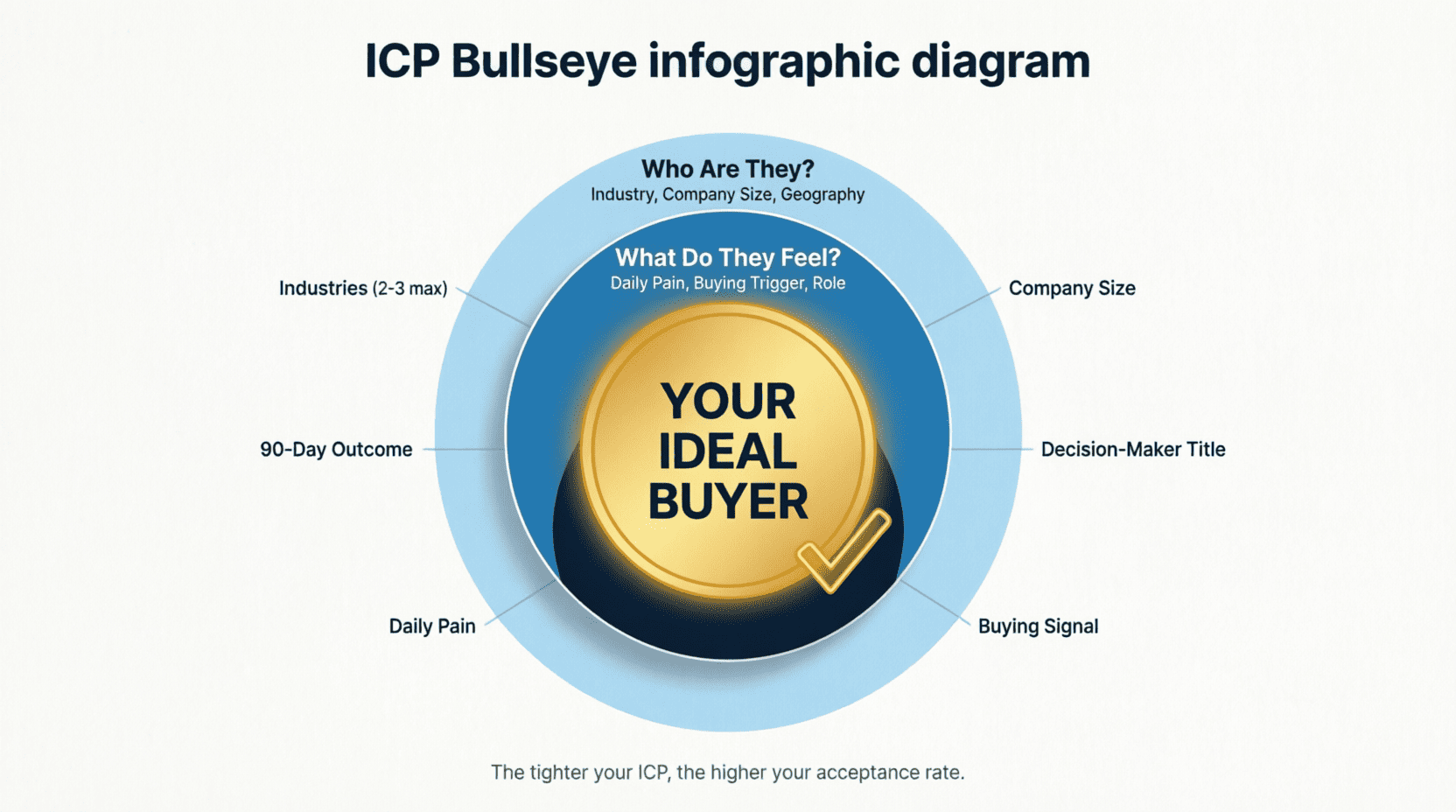
These answers don’t just shape your targeting, they write your messaging for you.
The tighter your ICP, the higher your acceptance rate. Every element of your outbound system flows from this foundation.
The LinkedIn Outbound System: A Four-Layer Framework
Think of effective LinkedIn prospecting not as a sequence of tasks but as a system with four interconnected layers. Neglect one, and the whole engine stalls.
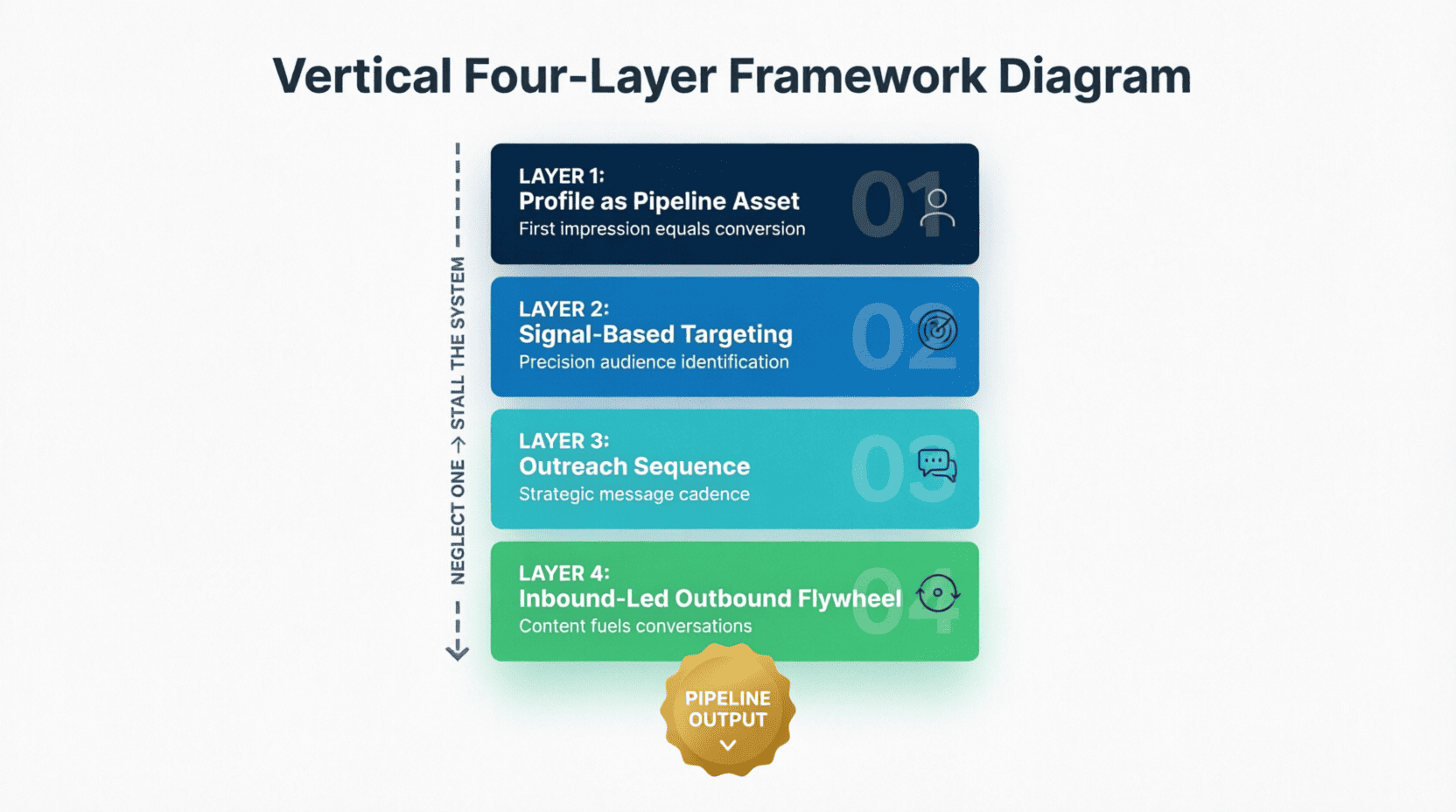
Layer 1: Profile as Pipeline Asset
Your LinkedIn profile isn’t your CV. It’s a landing page that either converts or not your outreach before you even send a message.
When a prospect receives your connection request, the first thing they do is click your profile. In those five seconds, they decide whether you’re credible or noisy.
Profile elements that convert:
| Profile Element | What It Should Do |
| Headline | Communicate who you help and the result you deliver not your job title |
| Banner Image | Reinforce your credibility: a tagline, client logos, or a key proof point |
| About Section | Open with their pain, explain your approach, close with social proof |
| Featured Section | Case studies, client testimonials, frameworks the evidence that converts skeptics |
| Recent Activity | Show 2-3 posts per week so prospects see a credible, active expert not a ghost |
A strong headline example: “Helping B2B SaaS companies generate $5M+ pipeline through LinkedIn Outbound without paid ads.”
Specific. Outcome-driven. Impossible to ignore.
A weak headline: “Co-Founder | Growth | Strategy.” Says everything and nothing.
Critical insight most guides miss: Spend 2-4 weeks posting valuable content before you launch any outreach campaign. This single step dramatically improves both connection acceptance and reply rates because your profile shows an active expert, not a cold stranger. Your content warms the relationship before the conversation starts.
Layer 2: Signal-Based Targeting (The Gap Most Competitors Miss)
Standard LinkedIn prospecting targets job titles. Advanced LinkedIn prospecting targets moments.
Buying signals tell you when a prospect is most likely to need what you offer. Timing your outreach to these signals can increase acceptance rates by 30-40% compared to cold, context-free outreach.
The most powerful buying signals to track:
- Hiring signals: A company posting for a VP of Sales or Head of Marketing is signaling investment. They have a budget and an active problem to solve.
- Role changes: Someone who just stepped into a new leadership role is building their toolkit. They’re open to ideas in the first 90 days.
- Funding announcements: Post-funding companies are actively spending. Your outreach aligned to their growth moment feels helpful, not random.
- Content engagement: A prospect who liked or commented on a post in your niche is already thinking about the topic. Reference it.
- Technology changes: Companies adopting or replacing specific tools are in motion. Your solution may fit that moment.
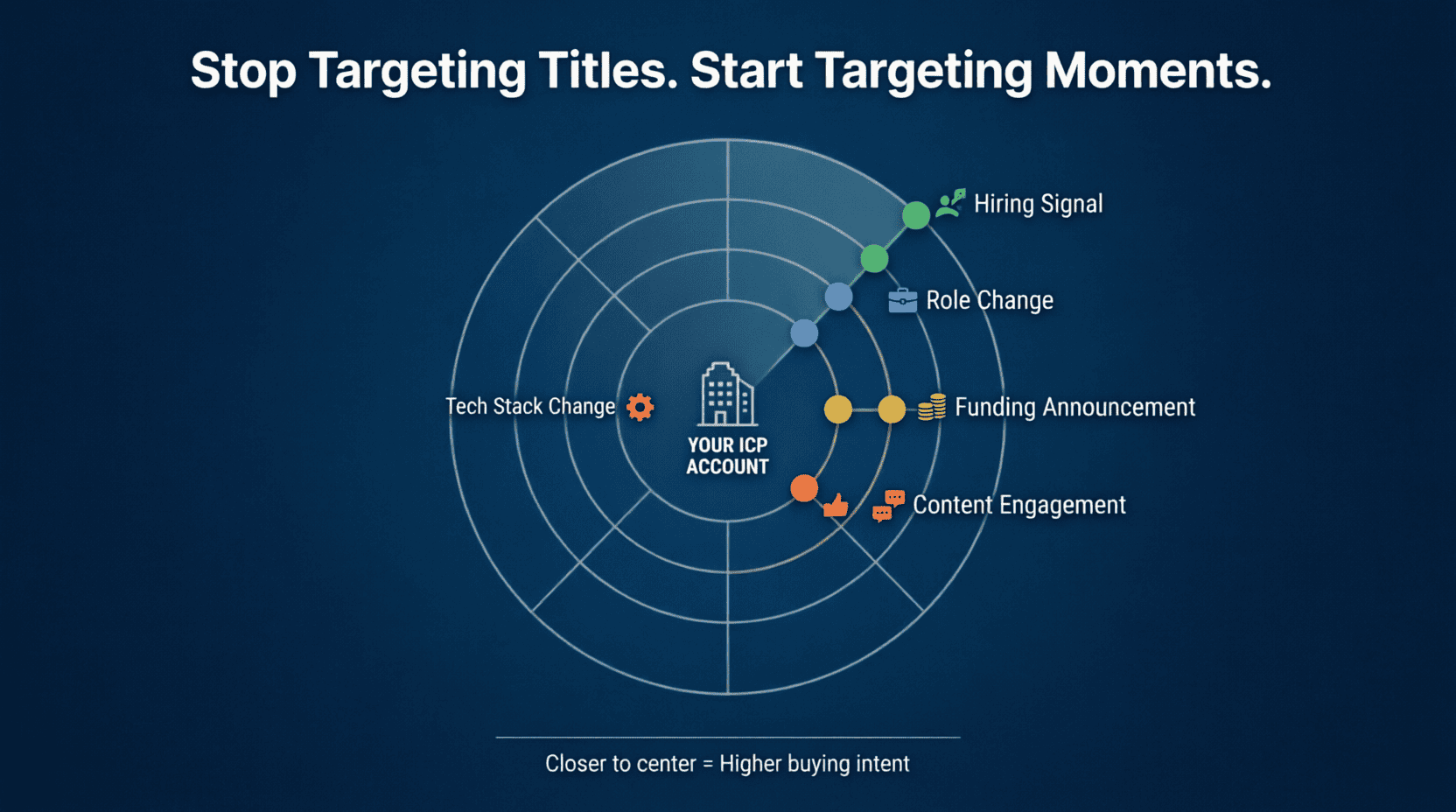
Sales Navigator’s real-time alerts make this practical. Set up saved searches by ICP criteria, enable lead and account alerts, and you get a fresh stream of signal-rich prospects flowing weekly without manual hunting.
Layer 3: The Outreach Sequence (What to Say and When)
This is where most guides spend all their time, but without Layers 1 and 2 in place, even the best copy underperforms.
The 5-Touch LinkedIn Sequence That Books Meetings
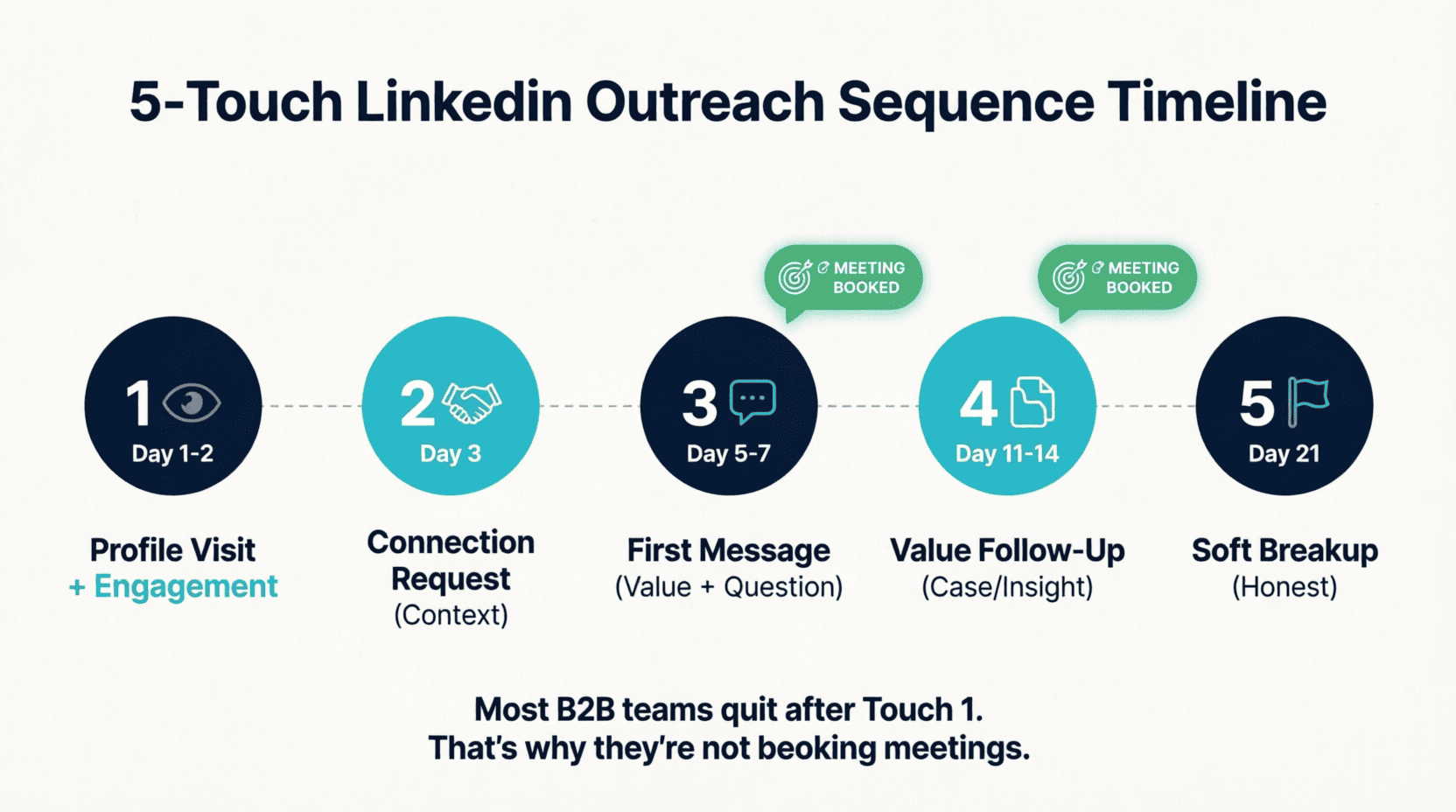
Touch 1: Profile Visit + Content Engagement (Days 1-2) Before sending a connection request to a high-value prospect, visit their profile and engage meaningfully with their recent content. A thoughtful comment, one that adds a perspective, not just “Great post!” makes you a recognizable face by the time your request lands.
Touch 2: Connection Request (Day 3) Keep the note short. Don’t pitch. Establish relevance.
Example: “Hi [Name], I saw your recent post on [topic] really aligned with how we think about [relevant themes]. Would love to connect.”
No ask. No demo request. Just a contextual, human invitation.
Touch 3: First Message Post-Connection (Day 5-7) The biggest mistake B2B teams make: pitching immediately after acceptance. Your first message should do three things: acknowledge the connection, deliver a small piece of value, and open a conversation not close a sale.
Example:
“Thanks for connecting, [Name]. I work with B2B teams that are scaling outbound. I came across a framework last week on [relevant challenge] that seems relevant to what your team is building, happy to share it if useful. How are you currently approaching [specific aspect of their challenge]?”
Touch 4: Value Follow-Up (Day 11-14) If there’s no reply, follow up with a piece of genuine value: a relevant case study, a contrarian insight, a specific observation about their industry. Not a reminder that you messaged them. A reason to respond.
Touch 5: Soft Breakup (Day 21) One final message that’s honest and light. This often generates the highest reply rate of the sequence.
Example:
“I’ve reached out a couple of times and haven’t heard back, no worries at all. If the timing isn’t right or this isn’t relevant, completely understood. If it ever becomes relevant, I’ll be here.”
This message respects the prospect’s time. And ironically, its honesty often gets a reply.
Message Personalization at Scale
Personalization doesn’t mean rewriting every message from scratch. It means identifying the one specific detail that proves you’re not spraying a template.
Use a 1-2-3 personalization stack:
- Company-level: Reference something specific about their business (a recent product launch, a hire, a press mention)
- Role-level: Connect your message to a challenge their specific function faces
- Human-level: Reference something they said or wrote their own words are your most powerful hook
LinkedIn outreach delivers 20-35% reply rates compared to cold email’s 4-5% up to seven times better performance. But only when executed with this level of contextual personalization.
Layer 4: The Inbound-Led Outbound Flywheel
This is the strategy gap that separates LinkedIn Impact clients from the crowd and the concept most competing guides overlook entirely.
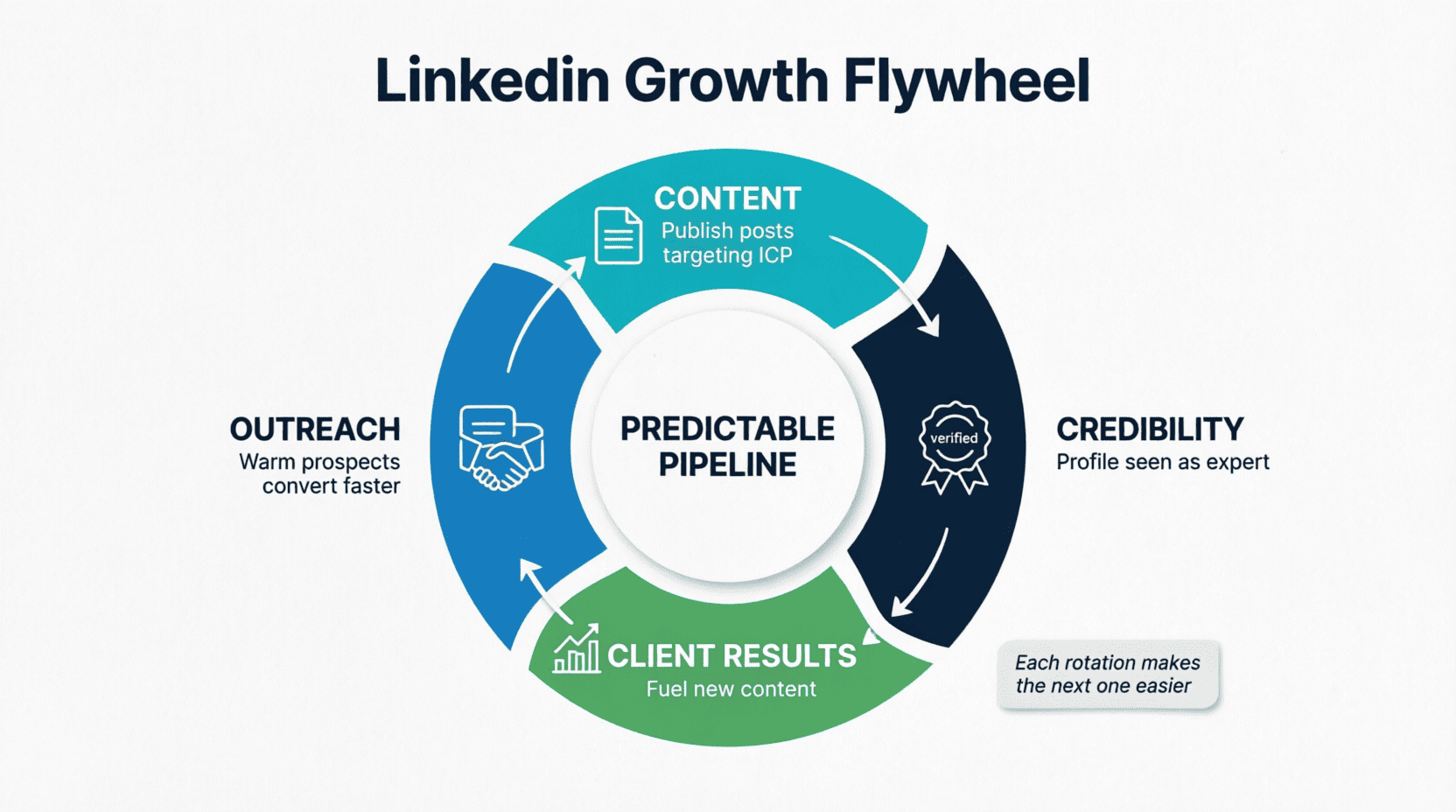
Inbound-led outbound means using content to warm up cold outreach before it happens.
Here’s how it works: you publish consistent, high-value content targeted at your ICP. Prospects engage with it. When your connection request or message arrives, you’re not a stranger you’re someone they’ve already learned from.
The result? Dramatically higher acceptance rates, faster trust, and shorter sales cycles.
What to post and how often:
- 2-3 posts per week frameworks, client lessons, contrarian takes, industry observations
- 1 carousel or document post per week step-by-step guidance prospects can save and share
- 1 case study or proof post per fortnight with permission, share a client result with the “before and after” framing
LinkedIn’s 2026 algorithm actively prioritizes conversation-worthy, expertise-driven content over viral fluff. You don’t need to go viral. You need to be consistently present and credible in front of the 500-2,000 people who matter most to your pipeline.
The flywheel effect: Content builds credibility → credibility improves outreach acceptance → outreach conversations generate clients → client results fuel new content. Each rotation compounds the one before it.
LinkedIn Prospecting Metrics: What Actually Matters
Generic benchmarks are nearly useless because performance varies by industry, audience, and offer. What matters is your baseline, and the direction it’s moving.
That said, here are reference points for well-optimized campaigns:
| Metric | Baseline Benchmark | Optimized Target |
| Connection Acceptance Rate | 25-30% | 35-45% |
| First Message Reply Rate | 10-15% | 25-35% |
| Meeting Conversion Rate | 5-10% from reply | 20-30% from reply |
| Follow-Up Reply Rate | 3-7% | 8-15% |
Track your first 100 connection requests and 50 messages to establish your context-specific baseline. Then measure improvement against that not against someone else’s numbers from a different industry and audience.
One timing insight worth noting: Research from Sopro’s analysis of LinkedIn outreach data shows that Tuesdays generate the highest reply rates. Competent outbound teams schedule and adjust timing deliberately rather than sending messages whenever the queue is ready.
When to Build In-House vs. Hire a LinkedIn Outreach Agency
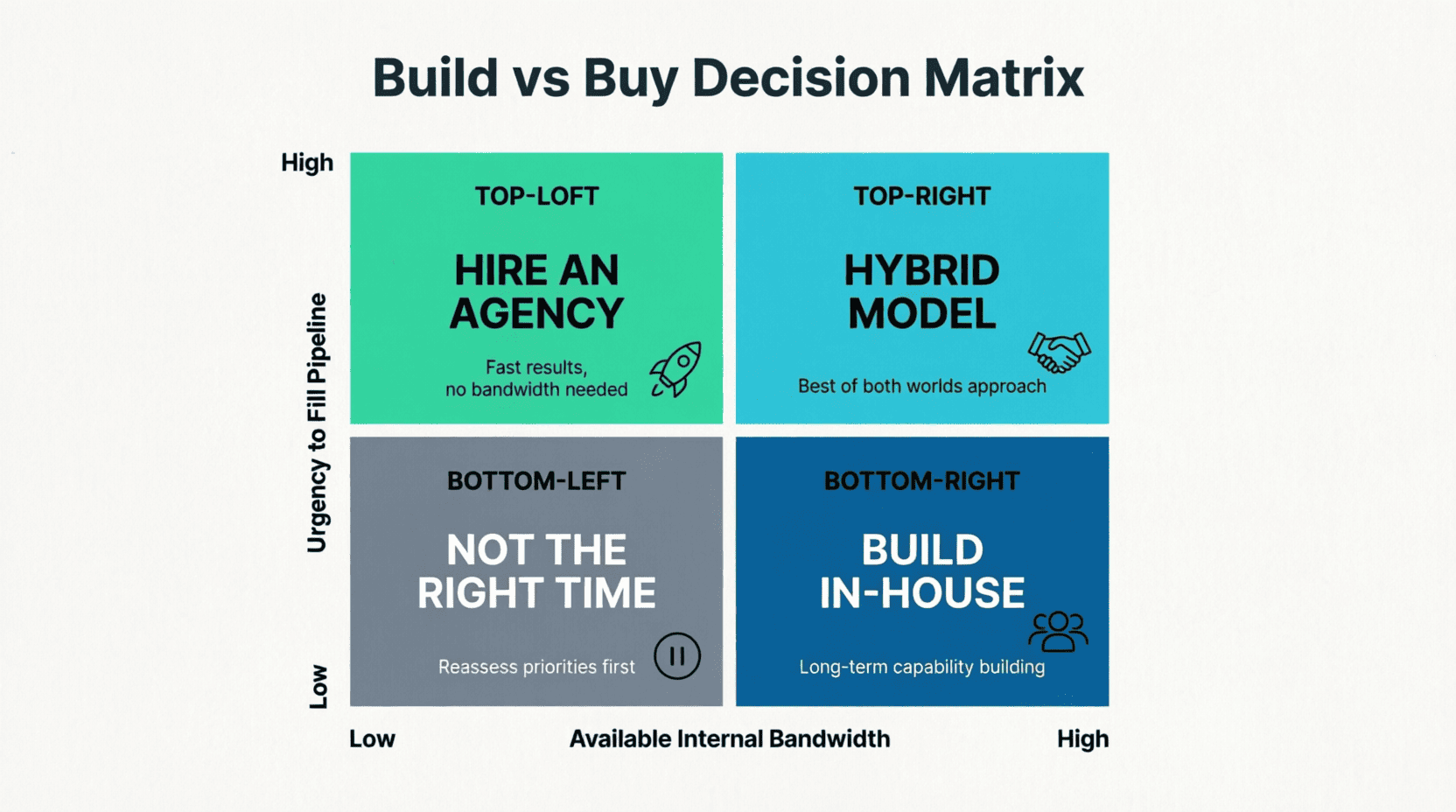
This is the question founders and CXOs often avoid asking directly but it’s the right one to ask early.
Build in-house when:
- You have a dedicated SDR or BDR with capacity to manage LinkedIn properly
- You’re in the early testing phase and need to validate messaging before scaling
- Your offer is highly technical and requires deep product knowledge in every conversation
- You have the time to build and iterate on targeting, sequences, and content simultaneously
Hire a LinkedIn outreach agency when:
- Your team is closing deals, not prospecting and pipeline is stalling
- You need a system built fast, not over 6-9 months of internal trial and error
- You want senior-level strategic input on ICP, messaging, and positioning not just execution
- You’re ready to scale a working model, not discover it
What separates a strong LinkedIn outreach agency from a mediocre one:
A weak agency scrapes a list, drops in a template, and calls it a campaign. A strong agency starts with your ICP, filters by role and account fit, adds context from buying signals, and turns that into messaging that gives the prospect a reason to care right now.
Five non-negotiables when evaluating any LinkedIn outreach agency:
- Transparency over tools They should tell you exactly what platforms they use and why, not hide operations behind “proprietary systems”
- ICP precision They should push back on vague targeting and force clarity before launching
- Quality over volume The right metric is qualified meetings booked, not connection counts or acceptance rates
- Brand-safe execution Your reputation is on the line when they message on your behalf; brand alignment isn’t optional
- Signal-led, not spray-and-pray They should use buying signals to determine timing, not blast the same list every Monday morning
One red flag worth noting: any agency that guarantees revenue. Serious operators know they can influence reply quality and meeting volume.
They don’t control your close rate, your sales process, or market timing. Guaranteed revenue is a claim that confuses pipeline influence with sales control.
The LinkedIn Prospecting Mistakes That Cost Campaigns
Even well-resourced teams make these errors. Knowing them is half the fix.
Mistake 1 Pitching immediately after acceptance: The connection is not a signal to sell. It’s the beginning of a conversation. The first message should deliver value and open dialogue, nothing more.
Mistake 2 Identical messages to multiple prospects: LinkedIn’s algorithm detects templated patterns and may restrict your account. Worse, prospects can feel a template.
Even small personalization signals referencing their company, their role, their content make the difference between a reply and radio silence.
Mistake 3 Ignoring follow-up: Most prospects don’t respond to the first message. The data consistently shows that follow-up messages, especially a well-crafted third or fourth touch generate disproportionately high reply rates.
Giving up after one message is one of the most expensive mistakes in B2B outreach.
Mistake 4 Treating LinkedIn as a standalone channel: LinkedIn outreach performs significantly better when coordinated with other touchpoints. Buyers crossing multiple channels before engaging is the norm, not the exception.
A cold email campaign with coordinated LinkedIn activity consistently outperforms either channel alone.
Mistake 5 Optimizing for vanity metrics: Connection count, acceptance rate, and total replies are inputs not outcomes.
The only metric that matters is qualified meetings booked with prospects who match your ICP. Track pipeline quality, not activity volume.
How LinkedIn Impact Approaches LinkedIn Outbound for B2B
At LinkedIn Impact, we’ve built a done-for-you LinkedIn outbound system specifically for B2B brands that need to fill the pipeline without adding headcount.
Our approach is simple in principle and precise in execution:
- We start with ICP definition that goes beyond job titles into buying signals, pain triggers, and role-specific language
- We optimize the sender’s LinkedIn profile to function as a conversion asset, not a digital CV
- We build content that warms prospects before outreach touches them
- We write sequences that feel personal because they are each message referencing context that proves we did the work
- We report on qualified meetings and pipeline quality, not vanity activity
The result is a LinkedIn channel that generates consistent demand without requiring your team to learn, manage, or iterate on the system themselves.
If you’re a founder, CXO, or B2B revenue leader ready to turn LinkedIn into a predictable pipeline channel, Let’s Talk
LinkedIn Sales Navigator: The Prospecting Engine Under the Hood
Most guides mention Sales Navigator in passing. Here’s how to actually use it as a precision targeting machine.
Sales Navigator isn’t just a better search tool, it’s a real-time intelligence layer on top of LinkedIn’s billion-person database. When used correctly, it transforms prospecting from guesswork into a systematic, repeatable process.
Building Your First Account-Based Target List
Start with accounts, not people. Define the companies that fit your ICP first, then identify the right contacts within them. This account-first approach mirrors how enterprise B2B buying actually works with multiple stakeholders, committee decisions, and account-level awareness.
Account filters to use:
- Company headcount (e.g. 50-500 employees for mid-market)
- Industry (be specific “SaaS” is not an industry; “HR Technology” is)
- Geography (city, country, or region)
- Growth signals (companies that are hiring, recently funded, or actively expanding)
- Technology used (via third-party data integrations where available)
Once you have a company list, layer on lead-level filters: seniority (Director and above, VP and above), function (Sales, Marketing, Operations), and keywords in their profile that signal relevance.
Save your search and activate alerts. Every time a new prospect fits your criteria a new hire, a promotion, a company that just started hiring Sales Navigator surfaces them automatically. This turns your targeting into a live, self-refreshing pipeline of signal-rich prospects.
Boolean Search: The Precision Layer Most Users Skip
LinkedIn’s standard keyword search is blunt. Boolean search is a scalpel.
Use these operators inside the title field in Sales Navigator:
- “VP of Sales” OR “Head of Sales” OR “Chief Revenue Officer” Casts a wider net across equivalent titles
- “Head of Marketing” NOT “Freelance” Excludes contractors and consultants when you’re targeting employees
- “Director” AND (“Demand Generation” OR “Growth”) Narrows to the exact function within a broader seniority band
Boolean targeting consistently outperforms standard keyword search for ICP match quality. Combined with company-level account filters, it’s the closest thing to a precision rifle that B2B prospecting has.
The Content-Outreach Integration: Why Silos Destroy Results
Here’s the mistake that kills otherwise solid LinkedIn outbound programs: running content and outreach as completely separate activities managed by different people with different goals and no shared intelligence.
Content tells you who’s engaged. Outreach converts who’s engaged. When they’re disconnected, you leave your warmest prospects untouched and spend all your effort on cold contacts who’ve never heard of you.
The integrated workflow looks like this:
- You publish a post on a topic directly relevant to your ICP’s pain point
- You monitor who engages specifically, who likes, comments, or shares
- Anyone who engages and matches your ICP goes to the top of your outreach queue
- Your connection request or opening message references what they engaged with
This is the difference between cold outreach and warm outreach disguised as cold outreach. The prospect clicked “like” on your post about scaling B2B pipeline. When your message arrives referencing that topic, it doesn’t feel like a sales pitch. It feels like a continuation of a conversation that was already happening.
Practical execution tip: Export or manually log your post engagers each week. Run them through your ICP filter. Anyone who qualifies gets a personalized connection note referencing the specific post they engaged with. This single tactic consistently outperforms standard outreach in both acceptance and reply rate.
Multi-Channel Coordination: LinkedIn in Context of Your Outbound Stack
LinkedIn should never operate as a silo. The highest-performing B2B outbound programs coordinate LinkedIn with email and, in some cases, phone, creating a multi-touch experience that feels coherent from the prospect’s side.
Here’s why this matters: buyers today cross multiple touchpoints before they engage. Research from Sopro found that 28% of buyers prefer to hear from sellers via social media, and more than half of the companies surveyed use LinkedIn to identify prospects.
Meanwhile, email and calling remain active channels for many audiences.
The coordination principle is simple: every channel should reinforce the others, not repeat them.
If you sent a LinkedIn connection request on Monday referencing their recent expansion into a new market, and your email on Wednesday lands with a relevant case study from a company in that same market, the prospect experiences a coherent, researched outreach motion not three random messages from three unrelated people.
A coordinated 10-day sequence example:
| Day | Channel | Action |
| Day 1 | Engage with prospect’s recent content | |
| Day 2 | Send connection request with context note | |
| Day 4 | First message post-acceptance (value + conversation opener) | |
| Day 6 | Relevant case study or resource aligned to your ICP pain | |
| Day 9 | Follow-up message referencing email resource | |
| Day 12 | Soft check-in with a new insight or data point | |
| Day 16 | Final touch honest, light, low-pressure |
This sequence doesn’t feel like a barrage because each message adds something new.
No repetition. No pressure. Just consistent, relevant presence across the channels your prospect actually uses.
Measuring What Matters: The LinkedIn Outbound Reporting Stack
Vanity metrics are the enemy of outbound improvement. Here’s what to track and what to ignore.
Metrics Worth Tracking
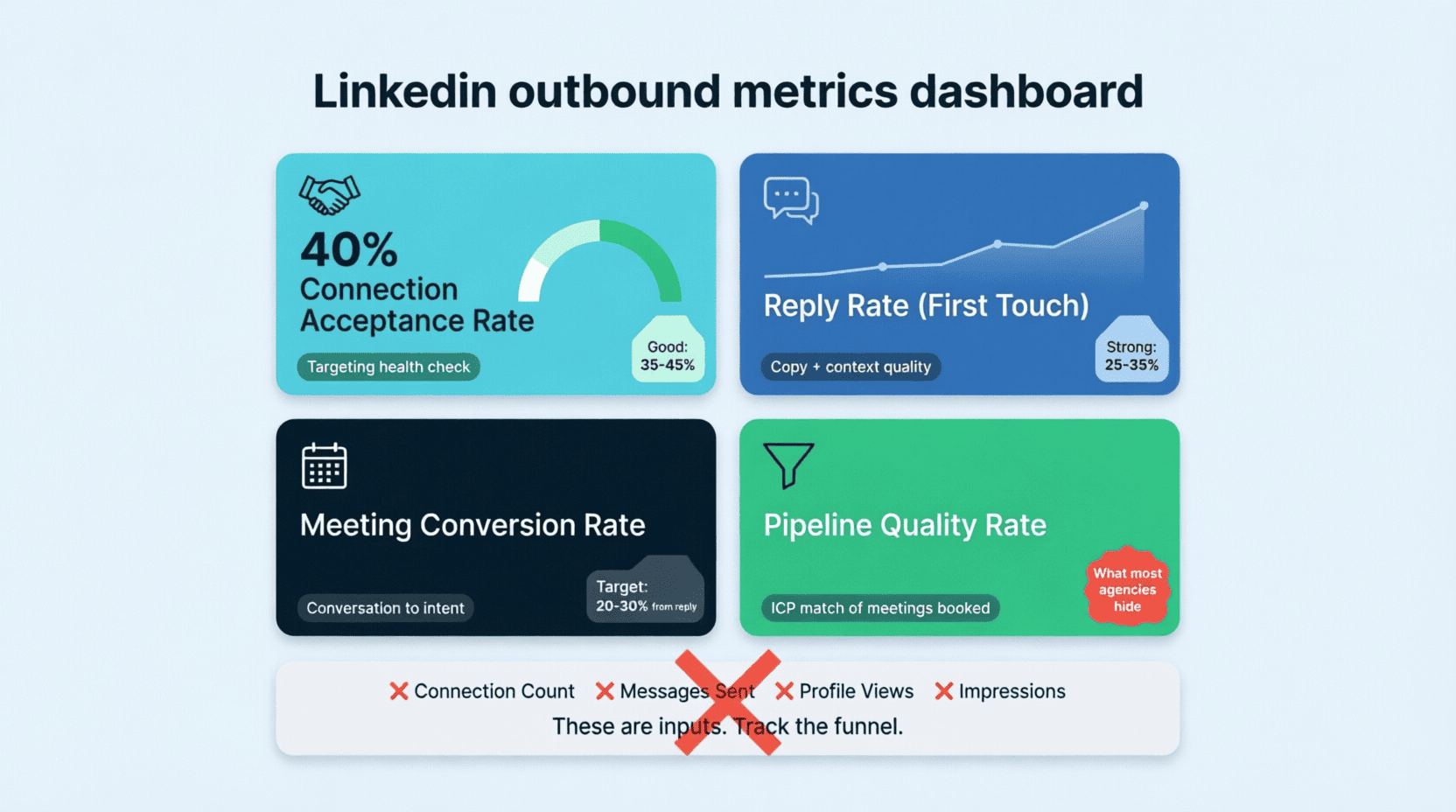
Connection Acceptance Rate: This is your first filter and tells you whether your targeting and positioning are dialled in before you even get to messaging. A rate below 20% signals a problem with your targeting, your profile, or your note.
Reply Rate (First Touch): Measures copy quality and contextual relevance. Benchmark: 10-15% is acceptable; 25-35% is strong for a well-optimized campaign.
Meeting Conversion Rate: What percentage of conversations translate to a booked meeting? This reflects how well your conversation handling converts curiosity into intent.
Pipeline Quality Rate: Of meetings booked, what percentage match your agreed ICP definition? An agency or SDR generating low-quality meetings is a costly problem that won’t show up in surface-level reporting.
Revenue Influenced: The ultimate measure. Not just meetings or pipeline, but deals that LinkedIn outreach contributed to, whether as first touch, assist, or close.
Neglect these metrics
- Total connection count Irrelevant if those connections aren’t in your ICP
- Total messages sent Volume is an input, not an outcome
- Profile views A vanity signal unless it’s tied to outreach activity
- Content impressions Only relevant if linked to outreach engagement data
The reporting principle: track the funnel, not the activity. Activity tells you how hard you’re working. The funnel tells you whether it’s working.
Building a Sustainable LinkedIn Outbound Rhythm
Consistency beats intensity on LinkedIn. A well-executed 90-day program outperforms a two-week sprint followed by six weeks of silence.
Here’s a sustainable weekly rhythm for a founder, CXO, or dedicated SDR managing LinkedIn outbound:
Monday: Review Sales Navigator alerts. Add 15-25 signal-qualified prospects to your active outreach list for the week.
Tuesday: Send connection requests for the week’s new prospects. (Tuesday has the highest reply rates per Sopro’s outreach data. Start your sequence on the day your first message is most likely to land well.)
Wednesday: Publish a piece of content targeted at your ICP’s pain point. Spend 20 minutes engaging with prospect content in your feed meaningful comments only.
Thursday: Send first messages to prospects who accepted earlier in the week. Review replies and respond to active conversations.
Friday: Follow up with prospects at touch three or four in your sequence. Log what’s working and what isn’t in your CRM or outreach tool.
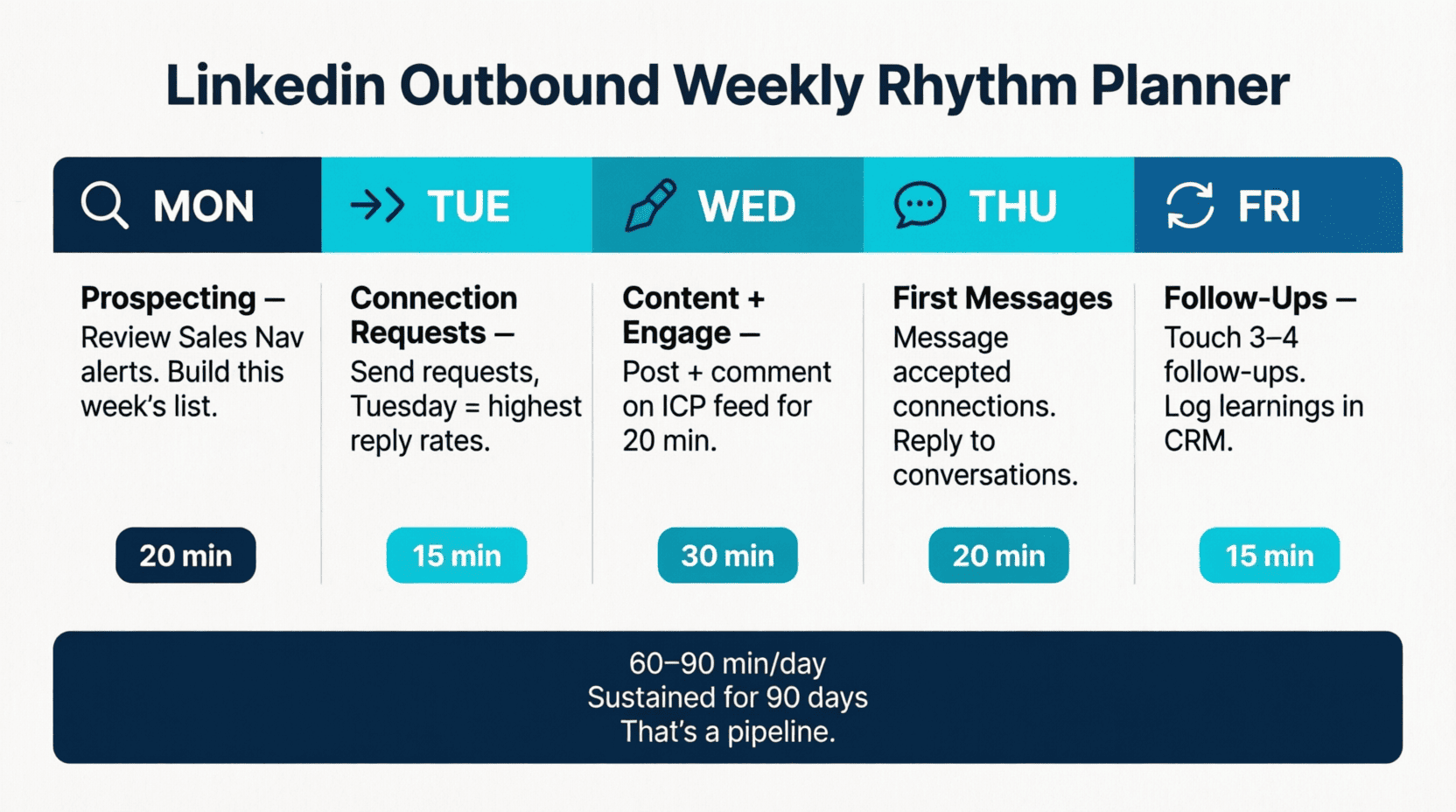
This rhythm requires roughly 60-90 minutes per day. Sustained over 90 days, it compounds into a meaningful, data-rich outbound program with clear benchmarks, tested messaging, and a growing pipeline of relationships in various stages of warming.
The teams and founders who do this consistently who show up every week without waiting for perfect conditions are the ones who look back after a quarter and realize LinkedIn became their top pipeline channel without a single dollar in ads.
LinkedIn Outreach Strategy related FAQs
Q1. What is LinkedIn prospecting, and how is it different from cold emailing?
LinkedIn prospecting is the process of identifying, connecting with, and building relationships with potential clients on LinkedIn to generate qualified pipeline. Unlike cold email, it operates inside a professional network where buyers expect business conversations which is why LinkedIn DMs deliver response rates two to seven times higher than cold email when executed correctly.
Q2. How many connection requests can I safely send per day?
The safe daily limit is 80-100 connection requests per account. Exceeding this consistently triggers LinkedIn’s risk detection and can result in account restrictions within 7-14 days. Start at 15-20 per day if your account is new or recently inactive, and increase gradually over two weeks.
Q3. What’s a realistic reply rate for LinkedIn outreach?
A well-optimized LinkedIn campaign targeting a defined ICP with personalized, signal-based messaging achieves 25-35% reply rates. The industry average is 20-25%. If your reply rate is below 10%, the problem is almost always targeting or messaging, not LinkedIn itself.
Q4. Do I need a LinkedIn Sales Navigator to run effective outreach?
Sales Navigator is not mandatory, but it is table stakes for serious prospecting at scale. Its Boolean filters, saved searches, account-based lists, and real-time lead alerts give you targeting precision that free LinkedIn search cannot match. For founders testing the channel on a small list, free LinkedIn search can work initially.
Q5. How do I know if I should hire a LinkedIn outreach agency or build in-house?
Hire an agency if your team is closing deals rather than prospecting, if you need a system built quickly rather than discovered over months, or if you want expert input on ICP, messaging, and positioning alongside execution. Build in-house if you have dedicated SDR capacity, are in an early testing phase, or need deep product expertise in every conversation.
